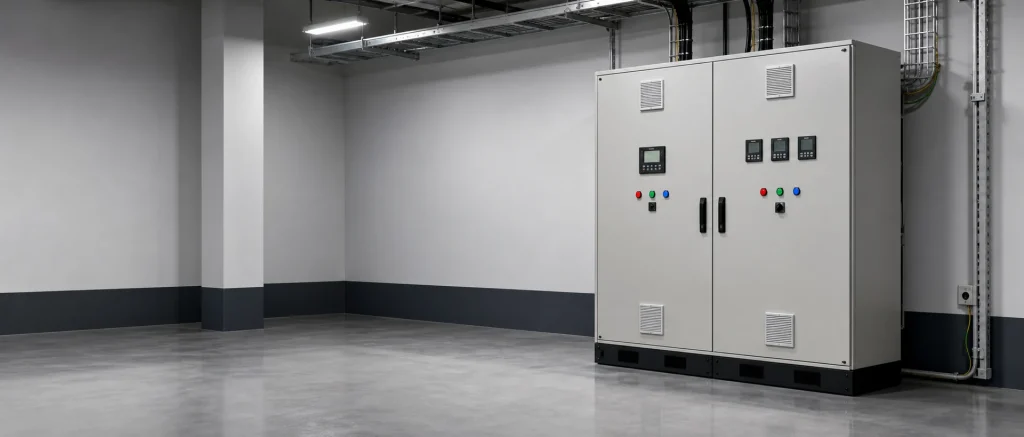
In most commercial buildings, a brief power interruption is annoying. In hospitals, clinics, laboratories, and other critical environments, it can become a serious operational risk. That’s why these sites don’t just “have a UPS” and call it done. They need the right distribution, the right segregation of loads, and a panel setup that behaves predictably during faults, maintenance, and switching events.
A well designed UPS panel is less about convenience and more about resilience. It’s built to protect essential services, reduce the chance of human error during stressful moments, and support maintenance without putting critical operations in a difficult position.
Why healthcare and critical sites have different power demands
Critical environments often run a mix of life safety systems, essential clinical loads, and “important but not critical” services. Not everything needs no break supply, but the things that do need it must be supported properly. Even short interruptions can cause equipment resets, loss of monitoring, or disruption to workflows that staff rely on to make quick decisions.
It’s also worth remembering that power issues aren’t always dramatic blackouts. Voltage dips, brief disturbances, and switching events can be just as disruptive for sensitive equipment. This is one reason critical environments often pay close attention to how power quality is managed and how essential circuits are protected.
What is a UPS panel?
A UPS panel is the distribution and control point for delivering UPS backed power to selected circuits. It helps manage how power is routed, protected, isolated, monitored, and maintained. In many installations, it sits within a wider electrical setup, so it needs to integrate cleanly with upstream distribution and downstream loads.
Rather than thinking of it as a “box that powers things during an outage”, it’s more accurate to see it as a structured way to deliver uninterrupted supply to the right services, while keeping the system safe and maintainable.
What sets UPS panels apart in critical environments
1) Reliability and resilience built into the design
In healthcare and similar settings, the design goal is often to reduce single points of failure and ensure the system remains controllable when something goes wrong. That affects how incomers, protection devices, and bypass routes are arranged. It also influences practical details such as termination quality, cable management, component selection, and panel layout.
Even if the UPS unit itself is high quality, weaknesses in distribution or switching can undermine the overall resilience. That’s why purpose designed UPS panels in critical environments focus on predictable behaviour under fault conditions and safe switching procedures.
2) Clear load segregation (so the right circuits stay live)
In most critical sites, not every circuit is placed on UPS. The aim is to support essential services without overloading the system or creating unnecessary complexity. A well structured UPS panel will typically make it easy to see what is supported, why it is supported, and how it is protected.
- Logical grouping of circuits by function, area, or risk category
- Clear labelling that matches drawings and site conventions
- Room for expansion as departments and equipment change over time
This is more than a neatness issue. When circuits are clearly segregated, it can reduce nuisance trips, improve fault finding, and make routine testing far less disruptive.
3) Bypass arrangements designed for real maintenance
Maintenance is where many critical power designs succeed or fail. Facilities teams need a way to service equipment without risking an avoidable interruption to essential loads. This is where bypass strategy matters.
A good bypass arrangement should be clear, safe, and usable in the real world. If the bypass route is confusing, requires too many steps, or isn’t well documented, it increases the likelihood of mistakes. In critical environments, the system should be designed to make the right action easier than the wrong one.
4) Monitoring, alarms, and integration with facilities management
Critical environments typically expect more visibility than a basic “on/off” status. UPS panels often need to provide alarms and monitoring outputs that support proactive maintenance and faster response times.
- UPS status and fault indications
- Breaker status and trip alarms
- Alarm outputs to a BMS or facilities monitoring system
- Clear local indicators that help teams diagnose issues quickly
The goal is early warning. If a problem can be identified before it becomes a failure, the site is in a much stronger position.
Documentation and compliance: why it matters more here
In critical environments, a panel isn’t truly “finished” until it’s handover ready. That usually means clear drawings, consistent labelling, test records, and documentation that reflects how the site actually operates. It’s not paperwork for the sake of it. It’s what allows teams to work safely, troubleshoot quickly, and maintain confidence in the system over the long term.
Where healthcare estates are involved, there are often additional governance expectations around testing, change control, and record keeping. Even outside healthcare (for example, laboratories or data-heavy environments), the same theme holds: if the documentation is vague, day to day operation becomes harder than it needs to be.
Common pitfalls in critical power projects
Underestimating future load growth
Healthcare environments evolve constantly. New equipment appears, services expand, and priorities shift. If the UPS panel design leaves no realistic allowance for expansion, it can force awkward retrofits later, often in the most inconvenient way possible.
Treating the UPS panel as an isolated component
UPS panels sit within a bigger system: upstream distribution, downstream protection, earthing strategy, and switching arrangements. A surprising number of issues appear at the interfaces, not in the headline equipment.
Poor maintenance access
If a panel is cramped, confusing, or difficult to isolate safely, routine maintenance can get delayed. In critical environments, postponed maintenance quietly increases risk.
How DSH Cables can support critical UPS panel requirements
If you’re specifying or upgrading a UPS panel for a critical environment, it helps to work with a team that understands the panel as part of a wider distribution system. DSH Cables & Controls designs and manufactures bespoke electrical solutions, which can be valuable where reliability, clarity, and maintainability are key.
Depending on your project scope, you may also find it helpful to explore:
- LV Switchgear for broader distribution integration
- Cable Assembly to keep interfaces consistent, labelled, and repeatable
- Reducing Downtime: Maintenance Best Practices for Custom Electrical Panels for practical maintenance thinking
- Contact DSH Cables if you want to discuss a requirement
A quick checklist before you specify
- Which loads genuinely require no break power, and which can tolerate changeover?
- How will the panel be maintained without risking avoidable interruption?
- What monitoring and alarm outputs are required for facilities teams?
- Is there a sensible allowance for future expansion?
- Are labelling and documentation aligned with how the site operates day to day?
Final thoughts
UPS panels in healthcare and critical environments are about controlled resilience. The strongest designs prioritise clarity, safe switching, maintainability, and predictable behaviour during faults. Done properly, the system doesn’t just keep power available. It keeps decision making calmer when things go wrong.